
Artificial intelligence is changing the internet faster than ever.
From AI-powered search engines and intelligent assistants to AI-generated videos and automated websites, the way people search, create, shop, communicate, and work online is evolving rapidly.
In 2026, AI is no longer just a tool running in the background. It is becoming part of the way we interact with the internet itself.
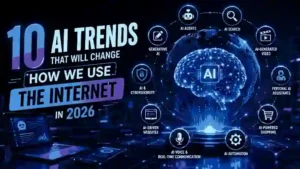
In this article, we’ll explore 10 AI trends 2026 is bringing to the internet and how these technologies could change the way we use the web.
1. AI Agents Will Do More Tasks for Us
One of the biggest AI trends in 2026 is the rise of AI agents.
Unlike traditional AI chatbots that mainly respond to questions, AI agents can potentially handle multi-step tasks based on a goal.
For example, an AI agent could help you:
- Research a topic
- Compare products
- Organize information
- Create a plan
- Write and edit content
- Automate repetitive tasks
- Work with multiple online services
Instead of simply asking AI for an answer, users are increasingly able to ask AI to complete a task.
This could change how people interact with websites and online services.
If you’re interested in this technology, check out our guide to the Best AI Agents in 2026.
2. AI Search Will Change How We Find Information
Traditional search engines usually provide a list of links.
AI-powered search is moving toward providing direct answers, summaries, comparisons, and follow-up conversations.
Instead of searching for:
“Best laptops for students”
a user might ask an AI search system to compare several options and explain which one is best for their specific needs.
This means search could become more conversational and personalized.
Websites will also need to adapt because users may discover information through AI-generated answers rather than clicking through traditional search results.
3. AI-Generated Video Will Become More Powerful
AI-generated video is developing rapidly.
Users can increasingly create videos from text descriptions, images, scripts, and other instructions without traditional video-production skills.
This can make video creation easier for:
- Creators
- Businesses
- Students
- Marketers
- Educators
- Social-media users
AI video tools can help generate scenes, animations, voiceovers, and other elements of production.
As these tools improve, creating professional-looking video content could become accessible to many more people.
You can also explore our article about 10 Best AI Image Generators in 2026 to see how generative AI is changing visual content.
4. Personal AI Assistants Will Become More Useful
AI assistants are moving beyond simple question-and-answer interactions.
Future assistants are becoming more personalized, remembering useful context and helping users complete tasks across different digital environments.
A personal AI assistant could help with:
- Planning
- Research
- Writing
- Scheduling
- Learning
- Organizing information
- Managing repetitive digital tasks
The goal is to make AI feel less like a separate application and more like a personal digital assistant.
This could change how people interact with their devices and online services.
5. AI Will Transform Online Shopping
Online shopping is another area where AI is becoming increasingly important.
Instead of manually browsing hundreds of products, shoppers may use AI to describe what they need and receive personalized recommendations.
For example:
“Find me a lightweight laptop for university with long battery life and a reasonable price.”
An AI shopping assistant could compare products, explain differences, summarize reviews, and help narrow down the choices.
This could make online shopping faster while also changing how people discover products.
6. Generative AI Will Become Part of Everyday Content Creation
Generative AI is already being used to create text, images, audio, code, and other types of content.
In 2026, these capabilities are becoming increasingly integrated into everyday software.
People can use AI to help with:
- Articles
- Presentations
- Emails
- Images
- Videos
- Music
- Coding
- Research
- Marketing content
The important change is that generative AI is becoming less of a separate novelty and more of a built-in feature inside the tools people already use.
If you want to explore more AI tools, see our guide to the Best AI Tools in 2026.
7. AI Voice and Real-Time Communication Will Improve
Voice interaction is becoming a much more natural way to communicate with AI.
Instead of typing every question, users can increasingly talk to AI and receive responses in real time.
AI voice technology can be useful for:
- Language learning
- Accessibility
- Customer service
- Personal assistants
- Education
- Hands-free tasks
As voice models become more natural, conversations with AI may feel increasingly similar to talking with another person.
However, better AI-generated voices also create new challenges, especially around impersonation and fraud.
That’s another reason why users should remain cautious about unexpected calls or voice messages.
8. AI Will Change Website Experiences
Websites are becoming more interactive and personalized.
Instead of presenting exactly the same experience to every visitor, AI can help websites understand what users are looking for and provide more relevant information.
For example, an AI-powered website could offer:
- Intelligent search
- Personalized recommendations
- AI customer support
- Interactive product guides
- Content summaries
- Conversational interfaces
This could make websites feel less like static pages and more like interactive digital assistants.
9. AI Automation Will Save More Time
Automation is one of the most practical AI trends in 2026.
AI can help automate repetitive digital tasks that previously required manual work.
For example, AI-powered automation can help users:
- Sort information
- Summarize documents
- Generate reports
- Organize emails
- Process data
- Create content
- Connect different applications
The biggest benefit isn’t simply doing more work.
It’s reducing the amount of time people spend on repetitive tasks.
This is especially useful for freelancers, businesses, marketers, developers, and anyone who works with large amounts of digital information.
10. AI and the Internet Will Create New Security Challenges
AI isn’t only changing how we use the internet. It’s also changing the security landscape.
Attackers can use AI to create more convincing messages, automate parts of scams, generate fake content, and imitate real people.
At the same time, cybersecurity teams can use AI to detect suspicious activity and respond to threats faster.
This creates a continuing competition between attackers and defenders.
For everyday users, basic security habits remain extremely important.
Read our guide on 10 Cybersecurity Mistakes That Put Your Data at Risk in 2026 for practical ways to protect your accounts and personal information.
How AI Could Change the Internet for Everyday Users
These trends aren’t happening separately.
They are gradually becoming connected.
Imagine searching for a product using AI, asking an AI assistant to compare the options, having an AI agent place the order, and then receiving an AI-generated video explaining how to use the product.
That kind of experience could become increasingly common.
The internet is moving from a place where people simply search, click, and read toward an environment where AI can help users understand, create, decide, and act.
What Should Internet Users Learn in 2026?
You don’t need to become an AI expert to keep up with these changes.
Start with a few practical skills:
- Learn how to use AI tools effectively.
- Understand basic AI limitations.
- Verify important information.
- Protect your accounts with strong security practices.
- Learn how AI-generated content works.
- Be cautious with realistic AI-generated voices and images.
- Explore automation for repetitive tasks.
- Keep learning as new AI tools appear.
These skills can help you benefit from AI without becoming overly dependent on it.
For more useful technology skills, check out 10 Tech Skills Everyone Should Learn in 2026.
Final Thoughts
The internet is entering a new phase.
AI agents, AI search, generative video, personal assistants, intelligent websites, automated workflows, and AI-powered shopping are changing how people interact with online information and services.
The most important part of these AI trends 2026 isn’t simply the technology itself.
It’s how people will use it.
AI can make the internet faster, more personalized, and more useful, but users will also need to understand its limitations and the new risks it creates.
The people who learn how to use AI responsibly and effectively will be better prepared for the next stage of the internet.