
AI skills to learn in 2026 are becoming essential for anyone who wants to stay competitive in a rapidly changing world.
Artificial intelligence is changing the way people work, learn, create, and solve problems. You do not necessarily need to become an AI engineer to benefit from this transformation. But learning how to work effectively with AI is quickly becoming an important advantage.
In 2026, knowing how to use AI tools is only the beginning. The people who stand out will be those who can combine AI with human judgment, creativity, communication, and technical skills.
So, what AI skills should you learn now?
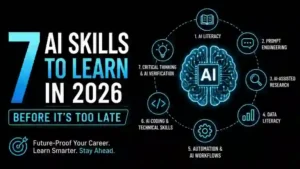
Here are 7 AI skills that can help you stay competitive in 2026 and beyond.
1. AI Literacy
The first skill everyone should develop is basic AI literacy.
You do not need to understand every technical detail behind machine learning models. However, you should understand what AI can do, where it performs well, and where it can make mistakes.
AI literacy includes understanding concepts such as:
- Generative AI
- Large language models
- Machine learning
- AI assistants
- AI agents
- AI automation
- AI hallucinations
- AI limitations
This knowledge helps you make better decisions when using AI at work or in everyday life.
For example, instead of simply asking an AI chatbot to complete a task, an AI-literate user knows when the answer should be verified and when human judgment is still necessary.
Why it matters: AI is becoming a general-purpose technology. Understanding it is increasingly useful regardless of your profession.
2. Prompt Engineering
Prompt engineering is the ability to communicate effectively with AI systems.
Although modern AI models can understand natural language much better than earlier systems, the quality of your instructions still matters.
A good prompt can provide:
- Clear context
- A specific objective
- Relevant information
- Desired output format
- Constraints
- Examples
Instead of asking:
“Write an article about cybersecurity.”
You could provide the audience, purpose, tone, structure, keywords, and length you want.
The result will usually be much more useful.
But prompt engineering is becoming more than simply writing clever prompts. The real skill is knowing how to structure a problem so an AI system can solve it effectively.
3. AI-Assisted Research and Fact-Checking
AI can help you research topics faster, but faster does not always mean more accurate.
AI systems can produce convincing answers that contain outdated, incomplete, or incorrect information. That’s why learning how to verify AI-generated information is becoming an important skill.
A strong AI-assisted research workflow might look like this:
- Ask AI to help identify important questions.
- Use AI to organize the research.
- Find reliable primary or authoritative sources.
- Compare information from multiple sources.
- Check dates and statistics.
- Review the final answer yourself.
This combination of AI speed + human verification is much more powerful than blindly trusting an AI-generated answer.
4. Data Literacy
AI runs on data, which makes data literacy increasingly valuable.
You do not have to become a data scientist. But understanding how to interpret data can give you a major advantage when working with AI.
Useful data skills include:
- Understanding percentages and averages
- Reading charts
- Identifying trends
- Recognizing misleading statistics
- Working with spreadsheets
- Understanding basic data quality
- Making decisions based on evidence
For example, an AI system might summarize thousands of rows of business data in seconds. But you still need to determine whether the data is reliable and whether the conclusion actually makes sense.
AI can process information. You need to understand what that information means.
5. Automation and AI Workflows
One of the biggest opportunities in AI is not simply generating text or images. It is using AI to automate repetitive work.
People who understand AI workflows can connect different tools and create systems that reduce manual tasks.
For example, an AI workflow could:
Receive information → analyze it → make a decision → generate content → send the result
Automation can be useful for tasks such as:
- Content research
- Customer support
- Email organization
- Data analysis
- Marketing workflows
- Document processing
- Reporting
- Lead management
The important skill is learning to identify repetitive processes and asking:
“Could AI or automation handle part of this workflow?”
You do not need advanced programming to start exploring this idea.
6. AI Coding and Technical Problem-Solving
Coding is another valuable AI-related skill in 2026.
Interestingly, AI coding tools are making programming more accessible rather than making technical knowledge completely unnecessary.
AI can generate code, explain errors, refactor functions, and help developers build applications faster.
But developers still need to understand:
- Programming fundamentals
- Software architecture
- Debugging
- Security
- APIs
- Databases
- Testing
- Code quality
The advantage comes from combining technical knowledge with AI assistance.
A person who understands programming can use AI as a powerful development partner rather than simply copying whatever code it produces.
7. Critical Thinking and AI Verification
Perhaps the most important skill is also the most human one: critical thinking.
AI can produce answers incredibly quickly. That creates a new problem: people may accept information simply because it sounds confident.
Critical thinking means asking:
- Is this information accurate?
- What evidence supports it?
- What could be missing?
- Does the conclusion logically follow?
- Could the AI be wrong?
- Should I verify this independently?
This becomes especially important when AI is used for business, education, finance, software development, research, or other areas where mistakes can have real consequences.
The future will not simply belong to people who use AI the most.
It will belong to people who know when to trust AI, when to question it, and how to improve its output.
Which AI Skills Should You Learn First?
You do not need to learn all seven skills at the same time.
A practical learning path could look like this:
Beginner
Start with:
- AI literacy
- Prompt engineering
- Critical thinking
These skills can be useful regardless of your career.
Intermediate
Next, learn:
- AI-assisted research
- Data literacy
- AI automation
These skills can help you use AI more effectively for real-world tasks.
Advanced
Finally, consider:
- AI coding and technical problem-solving
This is especially valuable if you are interested in software, technology, automation, or building AI-powered products.
AI Skills vs. Traditional Skills
AI does not make traditional skills useless.
In many cases, it makes them more valuable.
Someone who understands marketing can use AI to create campaigns faster. A designer can use AI to explore more concepts. A developer can use AI to accelerate coding. A researcher can use AI to organize information.
The strongest combination is often:
Human expertise + AI capability
Instead of trying to compete directly with AI, learn how to use it to multiply your existing abilities.
How to Start Learning AI Skills in 2026
You do not need an expensive course or a complicated setup.
Start with one practical project.
For example:
- Use an AI assistant to research a topic.
- Build a small automation.
- Analyze a dataset.
- Create a simple application with AI assistance.
- Practice writing better prompts.
- Compare AI answers with reliable sources.
- Use AI to improve an existing workflow.
The goal is not to learn AI only in theory.
Build something with it.
Every practical project teaches you how AI behaves, where it works well, and where human input is still necessary.
Final Thoughts
AI is changing quickly, but you do not need to chase every new AI tool to stay relevant.
Focus on durable skills.
Learn how AI works. Learn how to communicate with it. Learn how to verify its answers. Understand data. Explore automation. Develop technical skills when they are relevant to your goals. Most importantly, strengthen your ability to think critically.
The technology will continue to change.
The ability to adapt will remain one of the most valuable skills you can have.
So if you have been waiting to start learning AI, 2026 is a good time to begin.